Cutting pressure is lower than normal
The pump reaches less pressure than before, or the pressure drops as soon as you cut. Almost always something leaks or is worn, so the pump has to deliver more water than it can.
A worn orifice has a larger bore, so more water flows out and the pressure falls.
How to check: Look at the stream: a worn orifice gives a wider, fuzzy stream. Try a new orifice of the same size.
| Photo | Art. no. | Description | Excl. VAT | |
|---|---|---|---|---|
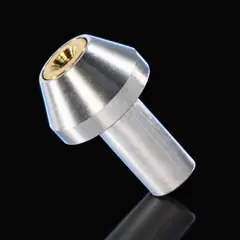 | 10226 | Orifice 0,10 mm, 1010
OrificeKMT |
€ 11.26 | |
| 10227 | Orifice 0,12 mm, 1012
OrificeKMT |
€ 11.26 | ||
| 10228 | Orifice 0,15 mm, 1015
OrificeKMT |
€ 11.26 | ||
| 10229 | Orifice 0,17 mm, 1017
OrificeKMT |
€ 11.26 | ||
| 10230 | Orifice 0,20 mm, 1020
OrificeKMT |
€ 11.26 |
Water passes the plunger and escapes at the weep hole of the end cap or HP cylinder.
How to check: Watch the weep holes on both ends while the pump runs.
A check valve that does not close lets water flow back, so each stroke delivers less.
How to check: After cutting (pressure released), compare the temperature of both sealing heads. One clearly hotter side leaks.
A clogged inlet filter or weak booster pump starves the intensifier.
How to check: Read the inlet pressure while cutting; replace filter elements if pressure drops over the filter.
Water lost at a fitting or valve is water the pump must make extra.
How to check: Check every fitting and the on/off valve for drips and wet weep holes.
Related problems
General advice based on manufacturer manuals and service practice. Always follow the manual of your machine. Not sure? .